
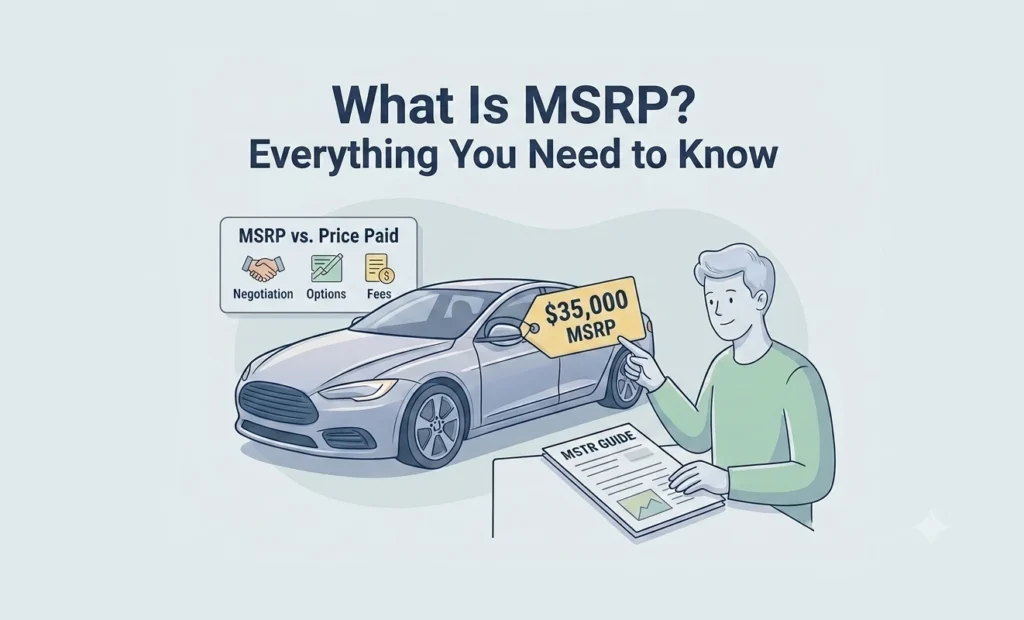
What is MSRP?
MSRP stands for Manufacturer’s Suggested Retail Price. It is the price a manufacturer recommends a retailer charge customers for a product. This price applies across many industries. Cars, electronics, and consumer goods all carry an MSRP.
The manufacturer sets this number before the product reaches any store or dealership. It creates a consistent pricing baseline across all sellers. Retailers are not legally required to follow it. They can price higher or lower based on their own business decisions.
For car buyers, MSRP is one of the first numbers they encounter. It appears on the window sticker of every new vehicle. Understanding it gives buyers a strong starting point for any price negotiation.
How is the MSRP Determined?
Manufacturers calculate MSRP with great care. They study production costs, market demand, and competitor pricing. Every factor plays a role in arriving at the final number.
The goal is a price that works for everyone. It needs to be fair to the buyer. It also needs to keep dealers and manufacturers profitable. Market research and historical sales data guide this process.
For vehicles, automakers also consider the cost of distribution, brand positioning, and regional demand. A high demand model will carry a stronger MSRP. A slow moving model may receive a more competitive price to attract buyers.
MSRP Typically Includes
The MSRP covers the core cost of the product itself. For a vehicle, it includes the base price of the car. It also covers any factory installed features and packages selected at the time of manufacturing.
Standard safety features are part of this price. So are any trim level upgrades that come directly from the factory. Technology packages added during production also fall within the MSRP.
The manufacturer builds all these elements into one clean number. This gives the buyer a clear picture of what the vehicle is worth straight from the factory floor.
Vehicle Research and Development Costs
Every vehicle starts long before it reaches the showroom. Engineers, designers, and safety teams invest years into building a new model. The MSRP carries a portion of these development costs. This is how manufacturers recover their investment in innovation and technology.
Vehicle Manufacturing Costs, Particularly Labor and Materials
Raw materials like steel, aluminum, and plastic form the body and structure of every vehicle. Skilled factory workers assemble thousands of components into one finished product. Labor wages, plant operations, and quality control all add to this cost. The MSRP reflects every dollar spent bringing that vehicle to life on the production line.
Vehicle Sales, Marketing, and Overhead Costs
Launching a new vehicle requires significant marketing investment. Television campaigns, digital advertising, dealership training, and promotional events all carry real costs. Manufacturer overhead including corporate operations also factors in. The MSRP absorbs these expenses so the product reaches buyers through a well supported sales network.
Standard Car Warranty and Service Coverage
Most new vehicles come with a manufacturer warranty included in the MSRP. This warranty gives buyers protection against factory defects and mechanical issues. Powertrain coverage and bumper to bumper plans are common inclusions. Buyers receive this peace of mind as part of the base purchase price.
MSRP Does Not Typically Include:
Sales Tax
Sales tax is a government charge applied at the point of purchase. It is calculated based on the final sale price and local tax rates. This amount sits completely outside the MSRP. Buyers should always calculate expected tax separately when budgeting for a vehicle.
Additional Government Charges or Taxes
Beyond sales tax, certain states and counties apply additional fees at the time of purchase. Environmental levies, luxury taxes, and regional surcharges can apply depending on the location. These are government mandated and vary widely across different states. None of them are reflected in the manufacturer’s price.
Registration, Title, and License Fees
Every new vehicle must be registered with the state. A title must be issued in the buyer’s name. License plates also carry their own processing fees. These costs are handled through state motor vehicle departments and are never part of the MSRP.
Documentation Fees
Dealerships charge a documentation fee to process paperwork involved in the sale. This covers contracts, title transfers, and filing responsibilities. Most states set a cap on how high this fee can go. Buyers should verify their state’s limit before finalizing any deal.
Dealership Fees
Dealers sometimes apply their own fees on top of the vehicle price. Lot fees, preparation fees, and administrative charges are common examples. These are dealer specific and not manufacturer controlled. Buyers have the right to question and negotiate these line items.
Dealer Installed Accessories and Add On Costs
Some dealerships add accessories after the vehicle leaves the factory. Floor mats, window tinting, paint protection, and security systems are common additions. These items increase the final price beyond the MSRP. Buyers should review the window sticker carefully to identify any dealer added products.
Destination Fees
The destination fee covers the cost of shipping the vehicle from the factory to the dealership. This charge is set by the manufacturer and is the same regardless of how far the dealer is from the plant. It is a fixed and transparent cost. However it is listed separately and does not form part of the MSRP itself.
Extended Warranties
An extended warranty provides coverage beyond the standard manufacturer plan. Dealers offer these as optional add ons at an additional cost. They are never included in the MSRP. Buyers should evaluate the value of extended coverage based on the vehicle type and their personal driving needs.
Dealership Deals and Sales
Promotional offers, seasonal discounts, and dealer incentives are applied after the MSRP is established. These adjustments work in the buyer’s favor when available. They bring the final sale price below the manufacturer’s suggested figure. Always ask about active promotions before agreeing to any final number.
MSRP vs. Sticker Price? Are They Really the Same Thing?
Many buyers use these two terms interchangeably. They are related but not identical. Understanding the difference saves money at the dealership.
The MSRP is the price set by the manufacturer. The sticker price is the total number displayed on the vehicle’s window sticker at the dealership. This window sticker is also called the Monroney label.
The sticker price starts with the MSRP as its foundation. Then the dealer adds their own charges on top. Destination fees, dealer installed accessories, and additional packages all get added to the sticker. The final sticker price is almost always higher than the MSRP.
A smart buyer reads every line on that sticker. Each addition is a negotiation opportunity.
MSRP vs. Invoice Price? What the Dealer Actually Pays
The invoice price is what the dealer pays the manufacturer to acquire the vehicle. It sits below the MSRP in most cases. This gap between invoice and MSRP represents the dealer’s potential profit margin.
Knowing the invoice price gives buyers real negotiating power. It reveals the floor the dealer is working from. Many online tools and automotive research platforms publish invoice prices for popular models.
Dealers sometimes sell near or at invoice price to move inventory quickly. They still earn through manufacturer bonuses, holdbacks, and financing commissions. So a deal at invoice price can still be a profitable transaction for the dealer.
The closer a buyer negotiates to invoice price the stronger the deal they are getting.
MSRP vs. Base Price? The Starting Point Before Options
The base price is the cost of a vehicle in its most basic configuration. It includes no optional features, no upgrade packages, and no added technology. It is the absolute entry point for that model.
The MSRP builds on top of the base price. When a manufacturer adds features, trims, or packages to a vehicle the price rises above the base. The MSRP reflects the specific configuration of the vehicle being sold.
Think of the base price as the foundation and the MSRP as the completed structure. A fully loaded trim level will carry an MSRP significantly higher than the base price of the same model.
Buyers should always compare both numbers when evaluating a vehicle’s true value.
When Would You Pay More Than the MSRP?
MSRP is a suggestion not a legal ceiling. Dealers have full freedom to price vehicles above it when market conditions support doing so.
New model launches create strong demand. Limited production vehicles attract intense buyer competition.
When supply is low and demand is high dealers apply a markup over MSRP. This additional charge is commonly called a market adjustment or dealer markup.
During supply chain disruptions vehicle inventory tightens across the country. Buyers who need a vehicle immediately often face above MSRP pricing as their only option.
Exclusive or collector edition models carry premium pricing by design. Manufacturers and dealers both recognize the value these vehicles hold in the market.
Paying above MSRP is a personal decision. Buyers who can wait often find better pricing as demand cools. Buyers who need a specific vehicle immediately may find it worthwhile. Either way knowing the MSRP clearly defines exactly how much above market value is being paid.
Problems With MSRP — Why the Suggested Price Is Not Always the Right Price
MSRP serves as a useful pricing guide. However it carries real limitations that every buyer should understand before walking into a dealership.
It Is a Suggestion Not a Guarantee
The word “suggested” holds significant meaning. No law requires a dealer to honor the MSRP. Dealers can price above or below it freely. This creates inconsistent pricing experiences across different dealerships for the exact same vehicle.
It Does Not Reflect Real Market Conditions
Manufacturers set MSRP months before a vehicle reaches showrooms. Market conditions shift constantly. Fuel prices, economic changes, and competitor launches all affect real world vehicle value. The MSRP cannot always keep pace with these rapid changes.
It Can Create a False Sense of Value
Many buyers treat MSRP as the fair price. This assumption can work against them. A vehicle sitting on a lot for months may be worth negotiating well below MSRP. Relying solely on the suggested price means leaving potential savings on the table.
It Excludes Significant Costs
As covered earlier MSRP does not include taxes, fees, destination charges, or dealer additions. A buyer budgeting only for the MSRP will face unexpected costs at the time of purchase. The true out of pocket cost is always higher than the sticker suggests.
It Varies by Trim and Configuration
The same model can carry vastly different MSRPs depending on trim level and factory options. Buyers comparing prices across dealerships must ensure they are comparing identical configurations. A price difference may simply reflect different packages rather than a better deal.
MSRP DPH Meaning – What This Term Really Means
DPH stands for Delivered Price Here. MSRP DPH refers to the manufacturer’s suggested retail price that includes the cost of delivering the vehicle to the specific dealership location.
This term is particularly common in certain regional markets and older automotive pricing documents. It combines the base MSRP with the destination and delivery charge into one figure.
When a price is listed as MSRP DPH the buyer is seeing a more complete picture of the vehicle’s cost. It removes the need to add destination fees separately. This makes budgeting more straightforward from the start.
Buyers encountering this term should confirm exactly what costs are bundled into the DPH figure. Transparency here ensures no surprises appear later in the purchase process.
TSRP vs MSRP – Understanding the Difference
TSRP stands for Total Suggested Retail Price. It is a more comprehensive figure than the standard MSRP.
The MSRP covers the manufacturer’s base suggested price for a specific vehicle configuration. The TSRP goes further. It adds all associated costs including destination charges, mandatory fees, and sometimes dealer installed options into one combined total.
TSRP gives buyers a fuller picture of what they can expect to pay before entering any negotiation. It reduces the gap between the advertised price and the actual purchase price.
Some manufacturers and dealers use TSRP to provide greater pricing transparency. It builds buyer confidence by presenting a more honest total figure upfront. When comparing offers across dealerships always clarify whether the price shown is MSRP or TSRP. The difference between the two can be several hundred to several thousand dollars.
What Does MSRP Mean in Wholesale – A Different Pricing World
Wholesale pricing operates in a completely different environment from retail. In wholesale transactions MSRP still exists but it plays a different role.
Wholesale buyers typically include retailers, distributors, and resellers. They purchase products in bulk directly from manufacturers or authorized distributors. Their purchase price sits well below the MSRP.
In this context MSRP serves as a ceiling reference point. It tells the wholesale buyer the maximum price the product should be sold for in a retail setting. This protects brand value and maintains pricing consistency across all retail channels.
For example a wholesaler purchasing consumer electronics knows the MSRP of each unit. They buy below that figure and resell to retailers who then price at or near MSRP to generate their own margin.
In automotive wholesale the same principle applies. Fleet buyers, auto auctions, and dealer to dealer transactions all operate below MSRP. The suggested retail price remains the benchmark that anchors the entire pricing chain from manufacturer to end buyer.
Frequently Asked Question
Does MSRP Include Tax?
No. MSRP does not include any form of tax. Sales tax is a government imposed charge calculated at the point of purchase. It is based on the final negotiated sale price and the tax rate of the buyer’s state or county. Tax rates vary significantly across different locations. A buyer in one state may pay thousands more in tax than a buyer in another state for the exact same vehicle. Always calculate expected tax separately when planning a vehicle budget. Never assume the MSRP covers this cost.
Does MSRP Include the Destination Charge?
No. The destination charge is a separate line item on the window sticker. It covers the cost of shipping the vehicle from the manufacturing plant to the dealership. This fee is set by the manufacturer and remains consistent regardless of the dealership’s distance from the factory. Destination charges typically range from several hundred to over one thousand dollars depending on the vehicle brand and origin point. Always check the window sticker carefully to identify this charge as a separate cost from the MSRP.
How Much Below the MSRP Can I Pay?
The answer depends on several factors. Vehicle demand, inventory levels, time of year, and dealer motivation all play a role. On slow moving models buyers can negotiate anywhere from 5 to 10 percent below MSRP in favorable conditions. High demand vehicles offer very little room for discount. Vehicles sitting on the lot for an extended period present the strongest negotiation opportunity. Researching the invoice price before visiting a dealership gives buyers a clear target. Aiming for a price between invoice and MSRP is a realistic and achievable goal for most standard transactions.
How Do You Negotiate Against the MSRP?
Preparation is the most powerful negotiation tool available. Buyers who arrive informed always negotiate from a stronger position. Start by researching the invoice price of the exact vehicle configuration being considered. Use automotive research platforms to gather this data before stepping into any dealership. Get competing quotes from multiple dealerships for the same vehicle. This creates real competitive pressure that works in the buyer’s favor.
Focus the negotiation on the out of pocket total price rather than monthly payments. Dealers can manipulate monthly figures while keeping the overall cost high. Timing matters as well. End of month, end of quarter, and end of model year periods are when dealers are most motivated to close deals. Shopping during these windows consistently produces better outcomes for buyers. Stay calm, be patient, and be willing to walk away. A buyer who shows no urgency holds the strongest position at any negotiating table.
Does the MSRP Include the Destination Fee?
No. The destination fee is always listed separately from the MSRP on the Monroney window sticker. It is a fixed charge that every buyer pays regardless of their location or the dealership they choose. Unlike dealer fees the destination charge is non negotiable. It is a manufacturer set cost applied uniformly across all sales of that vehicle model. Budget for it as a guaranteed addition to the MSRP when calculating total vehicle cost.
Is the MSRP the Price You Pay?
Rarely. The MSRP is a starting reference point not a final transaction price. The actual amount a buyer pays depends on negotiation, dealer fees, taxes, destination charges, and any additional add ons. In most standard market conditions buyers pay somewhere between the invoice price and the MSRP. In high demand situations buyers may pay above MSRP. In slow market conditions motivated dealers may go below it. The MSRP gives buyers a clear and fair benchmark. It is the number every buyer should understand before beginning any purchase conversation.
Can a Dealer Go Below MSRP?
Yes. Dealers have full flexibility to price vehicles below MSRP when business conditions support it. This happens more frequently than many buyers realize. Dealers receive manufacturer incentives, holdback payments, and volume bonuses that protect their profitability even when selling below the suggested price. This means a below MSRP sale can still be a financially sound transaction for the dealership. Slow selling models, aging inventory, end of year clearance events, and manufacturer sponsored discount programs all create genuine below MSRP opportunities for buyers. Staying informed and negotiating confidently opens the door to these savings on a consistent basis.